
Car Rental Agreement: 7 Hidden Fees You'll Only Find in the Fine Print (2026)
Your car rental agreement hides fees that double your real cost. Here's what to look for before you sign — and how to spot them in seconds.

You found a rental car for $35 a day. By the time you hit “Confirm Booking,” it’s $85. You didn’t buy any upgrades. You didn’t add insurance. You just… clicked through.
That gap — $50 per day, quietly inserted — is almost entirely inside your car rental agreement. Not in the advertised price. Not on the summary screen. Buried in the contract language that 99% of travelers skip entirely.
This post breaks down exactly where those fees hide, what the legal language actually means, and how to catch them before you’re already at the counter.
Why Your Car Rental Agreement Is Designed to Confuse You
The Federal Trade Commission finalized its “Rule on Unfair or Deceptive Fees” in mid-2025. California passed AB 1374 to force total price transparency. The FTC called it a crackdown on “drip pricing.”
Rental companies adapted. They didn’t eliminate the fees — they restructured the language. Today, what used to read as a line-item surcharge is buried inside phrases like Ancillary Charges, Concession Recovery Fee, or Facility Cost Recovery. Each one sounds administrative. None of them are optional.
The result: even with new transparency laws, your car rental agreement is still one of the most financially loaded contracts you’ll sign on a vacation.
Here’s what’s actually in it.
1. The “Security Fee” — An Airport’s Cost Passed Directly to You
At select airports — Jacksonville (JAX) is the clearest recent example — a $3/day “Security Fee” has appeared as a line item in 2026 rental agreements. The description calls it an “airport authority pass-through.”
What that means in plain language: the airport charges the rental company for operating security staff and garage cameras. The rental company passes that cost directly to you through your contract, bundled inside the “Taxes and Fees” section where it looks like a government charge.
It isn’t a government charge. It’s the rental company’s facility overhead, reformatted to look like an external mandate.
What to look for in your contract: Any fee described as an “authority fee,” “facility charge,” or “airport cost recovery.” These are not regulated by the FTC’s mandatory disclosure — they exist in a grey zone between taxes and optional charges.
2. Toll “Convenience” Fees — The $5 Toll That Costs $130
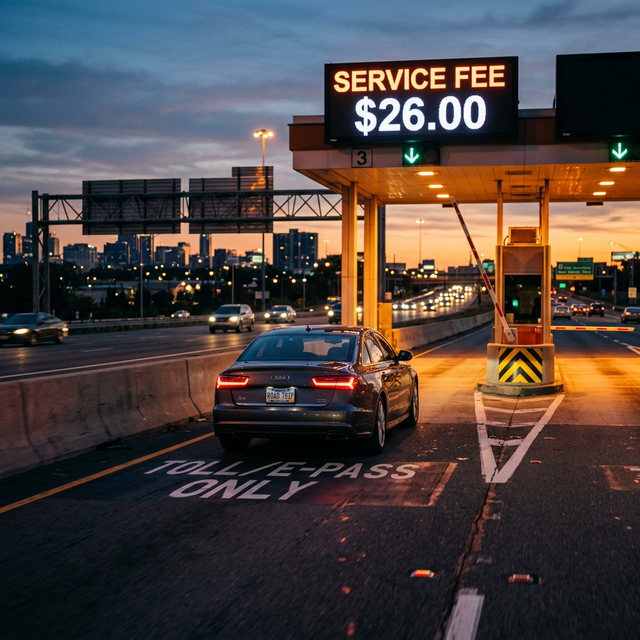
Most major rental companies — including Hertz and Dollar — use a third-party toll service called PlatePass. The way it works is almost designed to catch you.
If the rental car’s transponder is left active (which is the default) and you drive through a toll, PlatePass charges the toll plus a flat “service fee” of up to $26 per day — for the entire rental period, not just the days you used a toll road. A single accidental bridge crossing at the start of a five-day trip can generate over $130 in administrative surcharges on top of the $5 toll itself.
Lawsuits in San Francisco have documented exactly this pattern. The fee structure is technically disclosed in the rental agreement — but it requires reading several pages of fine print to find the daily service fee cap.
What to look for in your contract: A section labeled “Toll Services,” “Electronic Toll Collection,” or “PlatePass.” Check whether the fee is per-use or per day. The per-day version is the expensive one.
Practical fix: Bring your own E-ZPass or transponder. If the rental car’s PlatePass box has a physical shield or cover (many do), use it.
3. “Surveillance Pricing” — Two Customers, Two Different Prices
This is the newest and most difficult fee to catch, because it doesn’t appear in the contract at all — it shapes the price you’re shown before you ever get to the contract.
In early 2026, the California Attorney General launched a probe into what it calls “Surveillance Pricing”: the practice of using personal data — browsing history, device type, how frequently you visit a destination, what credit card you hold — to quote individualized prices. Two people standing at the same rental counter, booking the same car for the same dates, may be quoted rates that differ by 15–30%.
Unless a company explicitly discloses that it uses your data to set prices, you are likely paying a data-driven premium with no line item, no disclosure, and no recourse.
What to do: Search in an incognito browser with location services disabled. Compare quotes across devices if you’re seeing unusual price swings. This won’t show up in your car rental agreement — it determines what agreement you’re offered in the first place.
4. The “Cleaning” Surcharge — Now Broader Than You Think

Smoking fees have existed for years. What’s changed in 2025–2026 is how broadly rental companies now define “excessive cleaning” in the contract language.
Modern agreements routinely include clauses covering:
- Pet hair — even if the interior is otherwise spotless
- Sand — a deliberate catch in Florida and California markets
- Odors — which now includes food, moisture, or “dampness,” not just smoke
The practical problem: “odor” and “dampness” are entirely subjective assessments made by the lot attendant after you return the car, without you present.
What to do before you drive off: Insist the rental agent documents existing odors or debris in writing on the contract. If they won’t, record a timestamped video walkthrough of the interior. This video is your only evidence if a cleaning charge appears on your credit card a week later.
5. Young Renter Fees — Higher Than the Daily Rate Itself
Drivers under 25 expect a surcharge. What most don’t know:
In states like Texas, young renter fees can be waived for business rentals but doubled for leisure use — a distinction buried in the fee schedule section of your car rental agreement, not flagged during booking.
These fees range from $20 to $50 per day. On a base rate of $35/day, a $45 young driver surcharge means you’re paying more in fees than for the actual car. The FTC’s drip pricing rule was supposed to surface these earlier in the booking process, but rental companies frequently still don’t display them until the final confirmation screen.
What to look for: A section labeled “Additional Driver Fees” or “Driver Age Policy.” Check whether the fee applies to leisure versus business use specifically. If you’re renting for any business purpose, ask whether documentation waives the fee — some companies honor this.
6. One-Way Drop Fees — Not Included in the Total You Saw
Planning a road trip that starts in one city and ends in another? The base daily rate you were shown almost certainly doesn’t include the one-way drop fee.
This is a flat administrative charge that rental companies add for the “inconvenience” of relocating the vehicle. Unlike mileage fees, it has nothing to do with how far you drove. According to 2025 pricing data, drop fees vary by hundreds of dollars depending on destination supply and demand — a car returned to Portland, ME from Boston may carry a dramatically different fee than the reverse.
The fee appears in the “Rental Terms” or “Return Policy” section of the agreement, not in the price summary.
What to look for: Search explicitly for “one-way fee,” “drop charge,” or “return change fee” in your car rental agreement before booking. Also check whether the “Total Price” displayed includes this fee or excludes it.
7. Insurance Upsells — You May Already Have This Coverage

At the rental counter, agents are trained to sell Collision Damage Waivers (CDW). The pitch is fear-based: “If anything happens to this car, you’re fully liable.” The daily CDW rate commonly runs $25–$35. For international rentals, mandatory local insurance packages can reach $225/day with a $5,000 security deposit hold.
What the agent won’t tell you: many premium credit cards already provide primary rental car insurance as a cardholder benefit. Cards like the Amex Platinum and several Capital One Travel products cover collision damage as the primary insurer — meaning you wouldn’t need to file through your personal auto policy at all.
Before you say yes to the counter upsell, call your credit card’s benefits line. For a five-day rental at $30/day, skipping the CDW saves $150. That’s not a small number.
What to look for in your car rental agreement: The exact coverage limit of the CDW, and whether it includes “loss of use” charges — fees the rental company charges while a damaged car is being repaired and can’t be rented. Some credit card policies exclude loss of use. Know which one you have before you decline.
How to Actually Read a Car Rental Agreement in Under 5 Minutes
The core problem with car rental agreements isn’t that the fees are illegal — most are disclosed. The problem is that a standard rental contract runs 30–45 pages, with fee schedules, insurance exclusions, and usage restrictions spread across multiple sections with no clear summary.
The keywords that signal a hidden fee are consistent across companies:
| Keyword in Contract | What It Usually Means |
|---|---|
| Concession Recovery Fee | Airport or facility overhead passed to renter |
| Ancillary Charges | Catch-all for miscellaneous fees |
| Loss of Use | Daily charges while a damaged car is off-road |
| Fuel Service Option | Pre-pay for a full tank at above-market rates |
| PlatePass | Per-day toll administration, not per-use |
| Young Renter Supplement | Age surcharge, may vary by trip purpose |
| Drop Charge | Flat relocation fee, not in daily rate |
If you’re uploading your rental agreement to Smart Summaries before signing, these are the exact terms the AI flags and explains in plain language — so you’re not hunting through a 40-page PDF at a rental counter while someone waits behind you.
Your Pre-Signing Checklist for 2026
Before you book:
- Search in incognito mode to reduce surveillance pricing exposure
- Check whether your credit card provides primary rental car insurance
- Verify the “Total Price” includes one-way drop fees if applicable
At the counter:
- Ask the agent to confirm the final total matches your booking confirmation
- If numbers differ, reference the FTC Rule on Unfair or Deceptive Fees — companies are legally required to honor the disclosed total
- Request the PlatePass box shield if you’re bringing your own transponder
Before you drive off:
- Record a timestamped interior video (odors, existing damage, debris)
- Confirm the agent has noted any pre-existing conditions in the contract
- Check the toll transponder is deactivated if you’re using your own
FAQ: Car Rental Agreement Questions People Actually Search For
Can a rental company charge me more than the price I was shown online? Under the FTC’s 2025 Rule on Unfair or Deceptive Fees, companies must disclose the maximum total price before payment. If a counter agent quotes a higher price than your confirmed booking, you can cite this rule. Document the original confirmation before you travel.
What happens if I decline CDW and get into an accident? Your personal auto insurance or credit card coverage kicks in — but only if you’ve confirmed in advance that it applies. Some credit card policies exclude rentals over a certain value or duration. Call your card’s benefits line before the trip, not after the accident.
Is the PlatePass service fee avoidable? Yes, if you bring your own transponder and physically shield the rental car’s PlatePass device. Many rental lots provide a cover for the transponder specifically for this purpose. Ask at the counter.
What counts as “excessive cleaning” in a rental agreement? The definition varies by company, but 2025–2026 agreements increasingly include pet hair, sand, and food odors. Document the car’s interior condition at pickup with a video — this is your primary protection against after-return cleaning charges.
How do I know if I’m being surveillance-priced? You often can’t know directly. Comparing prices across incognito browsers, different devices, or through a travel agent can sometimes reveal discrepancies. The California AG investigation may lead to disclosure requirements, but there are no mandatory notifications yet.
Do young driver fees apply to all rental types? Not always. In some states, fees are waived or reduced for business rentals. Check the “Driver Age Policy” section of your car rental agreement and ask specifically whether your rental purpose affects the fee.
What’s a one-way drop fee and how much does it cost? A flat charge for returning a car to a different location than pickup. Costs vary significantly by market — from under $100 to several hundred dollars — based on vehicle supply and demand at the destination. Always confirm it’s included in your displayed total before booking.
The Bottom Line
A car rental agreement is a financial contract, not a formality. The fees that double your daily rate aren’t random — they’re deliberately placed in sections most people skip. Knowing where to look changes what you pay.
If you don’t want to read 40 pages of rental legalese at a budget counter, upload your agreement to Smart Summaries. The AI reads the whole thing, flags the fee keywords in the table above, and gives you a plain-English summary in under a minute — before you hand over your credit card.
| *Last Updated: March 2026 | 9-minute read* |
Published by the Smart Summaries Team. Smart Summaries helps travelers and professionals understand complex contracts and documents using AI-powered plain-language summaries.
Use Smart Summaries to scan your document
Take a photo of any contract or agreement and get a plain-language breakdown in seconds.
download_for_offline Download for iOS — Free